Multiple Owners Corporations: Ever wondered how they are meant to operate?
As apartment developments in Melbourne become bigger and more complex with shared facilities and different areas requiring restricted access for security purposes, the creation of multiple owners corporations is becoming more common.
The concept is easy, one plan of subdivision, creates different types of common property areas, and multiple owners corporations that are responsible for managing and administering each area. The practical implementation of the correct operation of multiple owners corporations must reflect the fact that they are each separate legal entities with different membership pools, different responsibilities and with restricted powers to raise funds from their members.
The Statutory Framework for Multiple Owners Corporations in one Plan of Subdivision
The Subdivision Act 1988 in Victoria creates a statutory framework that allows a plan of subdivision for an apartment development to create not just one owners corporation and one type of common property, but multiple owners corporations each responsible for their respective common properties.
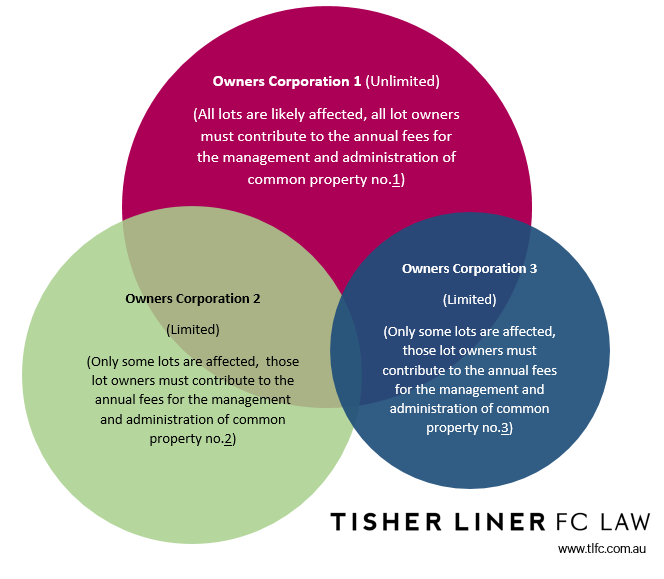
If a plan of subdivision creates common property, then it must also create at least one “unlimited” owners corporation. If a plan of subdivision creates multiple common properties, for example, common property no.1, common property no.2, common property no.3, then it is likely that the plan of subdivision also creates three owners corporations, one unlimited owners corporation (for example, Owners Corporation 1) and two limited owners corporations (for example, Owners Corporation 2 and Owners Corporation 3). Each of the owners corporations is a separate legal entity with its own distinct membership, voting proportions, proportions to contribute to annual fees and special levies and must hold their own separate annual general meetings and have their own separate committees.
Why is it important to ensure multiple owners corporations operate correctly?
The purpose of multiple owners corporations is to create an environment where all lot owners are members of the Unlimited owners corporation and therefore can access and use the areas common property no.1, and must contribute financially to the management and administration of common property no.1. However, only the members of the limited owners corporations are allowed to access, use and enjoy the common property areas managed and administered by their limited owners corporation.
For example, if there are two towers in an apartment development, the north tower and the south tower, and a shared common foyer area:
- the shared common foyer area may be part of common property no.1, managed and administered by Owners Corporation 1, and which can be accessed by all lot owners;
- the lifts leading up to the north tower may be common property no.2 managed and administered by the limited Owners Corporation 2; and
- the lifts leading up to the south tower and the common hallways in the south tower may be common property no.3 managed and administered by the limited Owners Corporation 3.
If you purchase an apartment in the south tower, your lot may be affected by Owners Corporation 1 and limited Owners Corporation 3, meaning that you can access, use and enjoy the areas of the building that are common property no.1 and common property no.3. But if you are not also a member of Owners Corporation 2, you will not have access to use common property no.2.
Financial Implications
From a financial perspective, the correct operation of multiple owners corporations is important because, using the above example:-
If you are a member of Owners Corporation 1, you must contribute to the annual fees of Owners Corporation 1 which relate to management and administration of common property no.1 areas;
If you are a member of Owners Corporation 3, you must contribute to the annual fees of Owners Corporation 3 which relate to management and administration of common property no.3 areas;
If you are not a member of Owners Corporation 2, then you have no legal liability to contribute financially to the annual fees of Owners Corporation 2 which relate to management and administration of common property no.2 areas. For example, if common property no.2 includes a swimming pool and gym, but you do not have access to that swimming pool or gym because you are not a member of Owners Corporation 2, you should not be paying for the repair or maintenance of those facilities.
Governance Implications
From a governance perspective, each Owners Corporation should have its own elected Committee that is made up from their respective membership pools only, to ensure that people who do not have a financial interest in the management and administration of a particular area of common property, are not involved in making decisions about that area.
At Tisher Liner FC Law, we have assisted multiple owners corporations who wish to transition to functioning in accordance with the law after many years of operating inconsistently with the provisions of the Subdivision Act 1988 and Owners Corporations Act 2006.
If your Owners Corporation would like advice about how multiple owners corporations created by your Plan of Subdivision are meant to be operating in accordance with the law, please send your enquiry to [email protected] so that we can give you a cost estimate for your Committee’s approval by majority vote.